

The Powerful Goal-Setting Formula for Creative People
Are you a creative person who needs help with goal setting? Does the SMART goal-setting process not work for your creative mind?
Oh, goals. They seem pretty straightforward: set the goal, do the steps it takes to accomplish it, and you’re done!
But unless your goal is to change the litter box or clean out the pantry, it’s a bit more complicated than that.
However, it doesn’t have to be that complicated. Once there’s a system in place, your goal accomplishment is going to go a lot smoother.
Why Traditional Goal Setting Falls Short for Creatives
If you’re a goal-setting type of person (hey, you are on It’s All You Boo’s website!), then you’ve heard of some traditional approaches.
You plan out your goal, break it down into ‘process goals’, and then just start with the first step!
This traditional approach, though it’s effective and simple, is a bit lacking in follow-through and doesn’t suit your average creative person, who tends to learn and manifest through visuals.
Another goal-setting technique that’s pretty common is the S.M.A.R.T. goal approach, which is a criterion for setting goals and an acronym for Specific, Measurable, Actionable, Relevant, and Time-Bound.
I’m an avid advocate for SMART goals, but it doesn’t encompass much past setting the actual goals. To see how the pieces fit, here’s a breakdown of goals versus objectives.
ALSO – this particular article is aimed directly at creative people, so the upcoming formula is going to cover everything from setting the right goal, all the way through to visualization, which is exactly where creative people excel.
Whether you dream up fine art, a new business, or beautiful campaigns, the Powerful Goal Setting Formula for Creative People is going to work for you.
And it’s something that you’ve never read about before now. (I’m 96% percent sure of that.)
The 8-Step Goal-Setting Formula for Creative People
Step #1: Write Out Your Goal
Before writing out your goal, be sure of the difference between a goal and a task.
A goal is going to involve multiple steps, regardless of the time frame. A task is obviously a lot simpler; use project management tools like Asana (my favorite!), Trello, or Notion to manage your tasks.
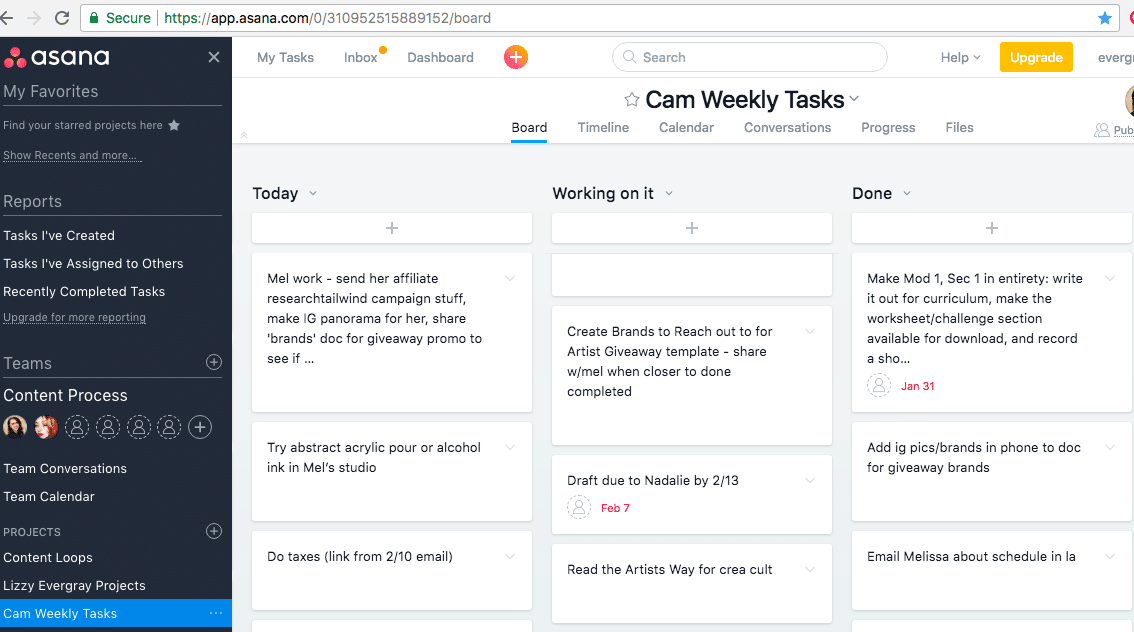
What I like to do when working on a goal is to make a column in Asana for the goal, and then add the little tasks to it underneath.
Here’s an example of my Asana workflow:
What’s your goal? And what tasks help you achieve it?
Write them out in a project management tool, or in a journal or document.
Step #2: Define the Reason or Why Behind Your Goal
This may not seem that important, or maybe it even seems obvious – the point of this step is to make sure that there’s not a better, more efficient goal that you could be setting.
For example – I’ve been setting goals for years, and when I first started out, my goal-setting techniques were on the amateur side (obviously). I now write out yearly goals and keep track of them quarterly.
But here’s an example of one of the first serious goals that I planned on accomplishing: I wrote this down on my personal Tumblr blog, in hopes of manifesting my way into accomplishing this goal through whatever means necessary.

The goal was this: be able to do a full pigeon pose by the end of the year. Sounds nice, right?
One of my major goals that year was to accomplish a tricky yoga pose. But it just seems silly now.
Here’s why: the reason that I wanted to accomplish that goal was that I wanted to exercise more in order to be healthier.
Lots of different ways to do this besides performing that coveted pigeon pose (which does look sooo pretty on Instagram).
A better goal for me to set that year was to cook healthy meals 3x a week, do a yoga practice 4x a week, or even just stretch for 20 minutes a few times a week.
When going by the S.M.A.R.T. goal setting criteria, my goal of getting to that full pigeon pose was not measurable or all that relevant.
What is the reason behind your goal? Why do you want to achieve it?
Step #3: Determine if There’s a Better, More Productive Goal to Focus On
Like my example of the ‘do a full pigeon by the end of the year’ goal, there was actually a much better goal to focus on there.
Had I really accessed the why behind that goal, I would’ve been much more productive that year.
(By the way – I never did end up doing a full pigeon – the goal just fell to the wayside amongst more important ones because my ‘why’ wasn’t strong enough).
Is there a better, more productive goal you can focus on?
Step #4: Write Out Your Revised Goal (If the Original Has Changed)
Maybe your very first draft of this goal is still correct, but now that you’ve validated it, you can go about accomplishing it with much more motivation.
Chances are though, you’ve revised your original goal from Step 1 at least a little bit, so write it down here.

Again, understanding the why behind this goal is not only going to give you more motivation to accomplish it, but it’s going to keep you focused on the right tasks. (With ‘right’ meaning the most productive.)
Is your goal the same? If not, what is your revised goal?
Step #5: Set Smaller Process Goals
Process goals are just the smaller, more broken-down version of your main goal.
So unless you wrote out a task instead of a goal, there’s going to be some smaller steps involved here. Write them out here, and put them in chronological order.
Here’s an example: if your goal is to film a parody music video (who isn’t?), then some of the process goals/steps would be:
- Research topic/idea – what else is out there? How can I stand out?
- Write lyrics
- Record vocals
- Setup & schedule a time with someone who’s going to be filming/helping out with it
- Scout & pick the locations
- Setup video equipment
- Film!
- Edit the video
- Market the video
So of course, there are even smaller steps involved (if only marketing was one step!), but the point is to write them out and organize them.
That way, you can literally go down the list and feel accomplished as you check each task off and get one step closer to your goal.
Breaking down a goal into process steps actually makes you more likely to reach your goal.
What are the steps or processes of your main goal? What are your mini goals?
Step #6: Make a Visual of Your Goal
This is an article about creative people after all – and most of us tend to be very visual. So here’s where that comes in.
Creative people have pretty active imaginations, and imagination comes into play before nearly anything can be manifested. Even something as simple as doing the dishes!
First, you picture what life and your house would be like if the dishes were done, and then you imagine up a way to get them done.
Your imagination can take many forms. In fact, I developed a theory that our imaginations produce 8 by-products, with a few of those by-products being creative projects, consumption mode, depression, and anxiety.
In my opinion, the best use of imagination is creation mode. Use that imagination to manifest big, beautiful, creative goals!
You’ve heard of vision boards, right? Let’s do that for your quarterly or yearly goals too!
Your vision board doesn’t have to be super long-term, bucket-list type of goals – make some sort of visual for Every. Single. Goal. Because you’re creative, and that’s what we like to do, and that’s what we excel at.

This visual doesn’t have to be a beautiful, glossy rendering – print out a little picture or sketch something up, even if your goal is more of an abstract concept.
How will you visualize your goal?
Will you create a vision board, or something else?
Step #7: Meditate and Set Your Intention to Make This Goal Happen
Dang, we’re getting into a lot of steps now for this whole goal-setting formula for creative people! But you want to accomplish this goal, right?
Take it from someone who has chronically been setting goals for many years – goal-setting is not casual for me, it’s serious business, brah.
When I meditate on a goal, I like to use crystals too. (Like amethyst, emerald calcite – anything like that). Meditate however you’d like, but here are some simple steps:
- Get your visual out, and stare at it for this entire meditation
- Say your goal out loud, and say your ‘why’ for why you want to accomplish that goal
- Say each of the process steps that it’ll take to reach this goal
- State your intention to finish this goal
- Repeat the above steps until it feels natural and obvious (About 5 – 10 times for me, usually)
How do you meditate on your goals?
Step #8: Get to Work & Measure Your Progress
So if you’re using something like Asana, (or whatever process you have going on to be productive), go ahead and schedule a time to finish the upcoming tasks.
The dates will probably shift a little, but that’s fine – give yourself a deadline to hold yourself more accountable.
Measuring your progress is important too because you can start to notice patterns about yourself.
This measuring can be as simple as asking yourself if you ended up completing the goal within the allotted time that you’ve given yourself. (Mine is actually that simple).
If I keep missing a goal quarter after quarter, I’m like – ‘Why? What is it about this goal that makes me keep letting it fall by the wayside?’
If the reason is just that it’s difficult and scary, then I’ll have a little chat with myself about why this goal needs to be worked on now.
But if the assessment as to why I’m putting that goal off is just that it’s not that important, then I’ll just let it go and move on – we only have so much time on this planet after all!
Figuring out how close you got to finish that goal can help you define how important that goal really is to you, and you can construct your future goals more effectively.
It’s the same discipline that helps you focus and follow through.
Bonus Step: Get Your Free Slay Your Goals Guide
Ready to get started on setting and achieving your wild, creative goals? Get your FREE Printable Slay Your Goals Guide.

 Sign up below for your FREE 10 Step Guide + weekly tips to help you slay your goals.
 Sign up below for your FREE 10 Step Guide + weekly tips to help you slay your goals.
Turn Your Creative Vision Into Goals You Actually Finish
Goal setting doesn’t have to feel rigid or boring when you’re a creative person. When you lean into what you’re already good at, like imagination and visuals, your goals start to feel a lot more doable.
Here’s the formula one more time:
- Write out your goal
- Define the why behind it
- Check if there’s a better, more productive goal
- Write out your revised goal
- Break it into smaller process goals
- Make a visual of your goal
- Meditate and set your intention
- Get to work and measure your progress
Don’t worry about getting it perfect the first time. Every goal you work through this way teaches you something about what matters to you and how you like to work, so the next one gets easier to set and easier to finish.
Grab the Slay Your Goals Guide and get started on your next important goal, you magical creator!
If you love this kind of mindful approach, see these quotes for every goal-setter, or plan a creative goal-setting day of your own.

Read More About How To Set Goals
- The Big Difference Between Goals and Objectives
- How to Set Ambitious and Actionable Business Goals
- How to Plan an Awesome Goal Setting Retreat
- 41 Motivational Goal Setting Quotes and Sayings
- 100 Personal End-of-Year Reflection and Review Questions
- 56 Experts Share Top Goal Setting Mistakes to Avoid
- The Powerful Goal-Setting Formula for Creative People
- How to Accept When Your Goals Change
- How to Project Manage Reaching Your Goals
- Why You Need to Be Setting Intentions Instead of Goals
- 6 Simple Secrets to Setting Achievable Goals

More About Guest Contributor
Cameron Gray is the founder of EvergrayDigitalMedia.com, whose focus is on helping ambitious artists and creative entrepreneurs take over the world through business & personal development via e-courses, webinar workshops, and PDF resources.
Last Updated on October 15, 2026


