

30 Gratitude Journal Prompts for Beginners Who Don’t Usually Journal
Looking for gratitude journal prompts for beginners that don’t feel like homework? Wondering what to write in a gratitude journal when you’re not even a journaling person?
It’s that time again. Everyone is talking about gratitude. Life is expensive, the news is exhausting, and somehow the advice keeps coming back to: have you tried being more grateful?
Honestly, sometimes it sounds like mental health budgeting. Stretch your patience. Make your happiness go further. Find something positive while everything else gets harder.
You can appreciate something in your life and still need your life to change. A gratitude journal doesn’t pay the bills. It can give you a small place to pause and notice something beyond what’s demanding your attention.
I’m Nadalie, goal-slaying coach and author of Conquer Procrastination. As a girly who isn’t naturally drawn to journaling, I’m making this one for us. The people who don’t want another blank notebook quietly judging them.
Think of this as lifting your head above water for a moment. Looking at the sky. Taking a little room back from the noise.
Pick one question. Give it one honest answer. You can stop there. No ten-item list. No perfect streak. Let’s make this easy enough to actually try.
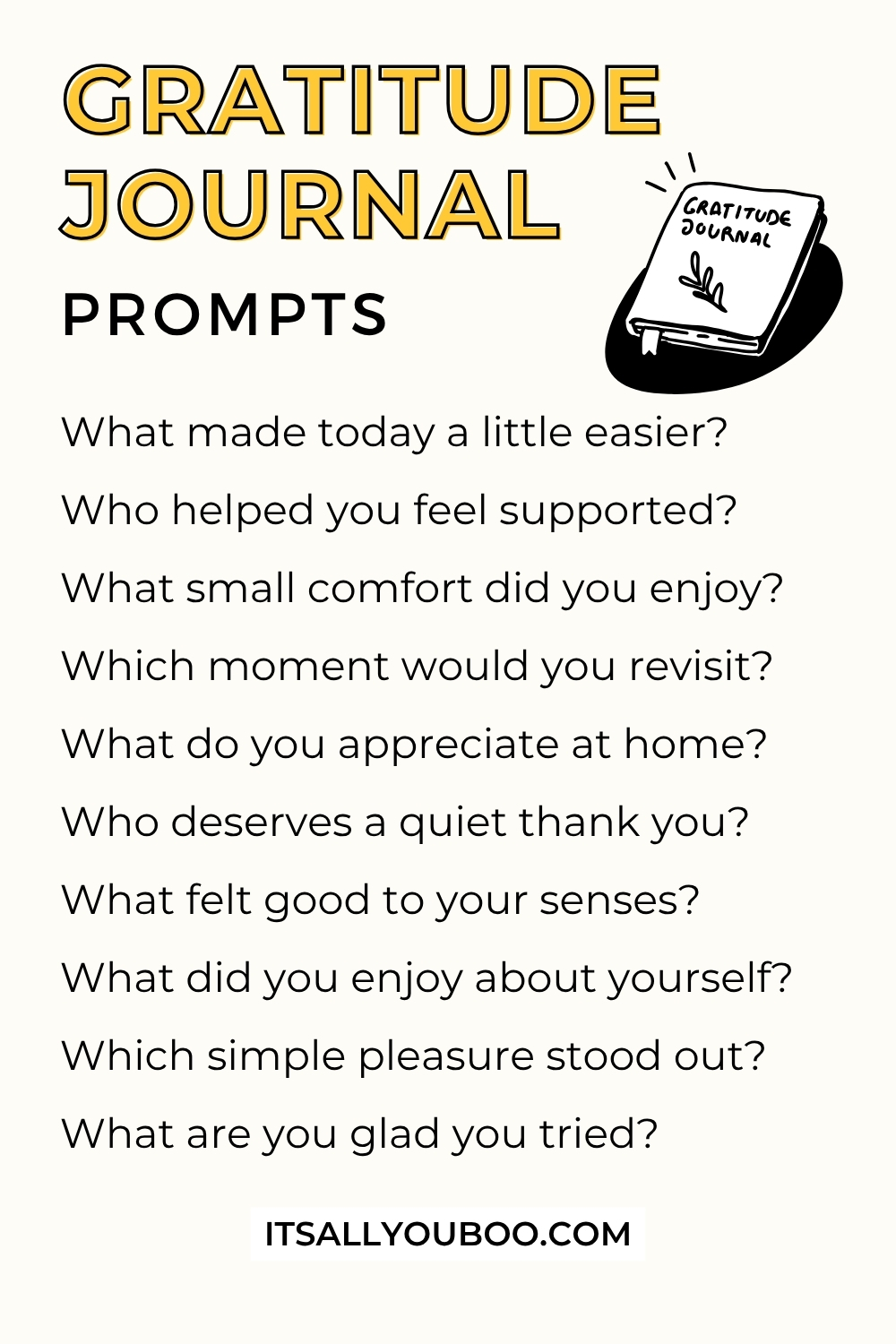
How to Use These Gratitude Journal Prompts for Beginners
You don’t have to read every prompt before you begin. Start with this: What’s one small thing I appreciated today? Answer it in a notebook, a phone note, or a short voice memo.
If you’d like a little more detail, add “because.” That’s your first entry: I’m grateful for my friend checking in because I didn’t have the energy to explain that I was struggling.
These prompts are options, not assignments. Choose the section that fits your day, skip anything that doesn’t, and come back when you want another question. For help with the broader habit, here’s a simple way to begin keeping a journal.
Prefer something ready to print? My free 30-day gratitude journal includes reflection questions to work through at your own pace. You’ll see a few of its gentler questions below, alongside new prompts written for this guide.
Watch: How to Reflect on What Went Well
Psychologist Martin Seligman explains the Three Good Things exercise in this short video. Notice the follow-up question about why something went well. You can borrow that invitation to reflect while starting with just one of our prompts; the video describes the fuller three-item exercise.
Why Try Gratitude Journaling in the First Place?
Researchers have tested specific reflection questions, rather than simply telling people to “be positive.” In Seligman and colleagues’ Three Good Things experiment, participants recorded three things that went well and why, each night for a week. The study found improvements in happiness and depressive symptoms at later follow-ups. Noticing the event and reflecting on its cause were both part of the exercise.
A later replication with stronger comparison conditions adds an important wrinkle: another positive-reflection activity also increased happiness, and the exercises didn’t outperform the control on depression. There isn’t one magic question. A prompt can offer a useful place to put your attention without being a guaranteed mood switch.
Use a prompt to recall a real moment, then notice why it mattered. That’s the idea behind the examples below. My one-question approach makes starting less demanding; it is an adaptation, not the three-entry research protocol, and these exact 30 prompts haven’t been clinically tested.
Think of it as one of the tools you can try for directing your attention. If you want more context, explore why gratitude can matter in everyday life. You still get to decide what feels useful to you.
Easy Gratitude Prompts for Your Very First Entry
Start here if a blank page makes your brain go equally blank. You don’t need an impressive answer or anything remotely profound.


#1. What’s one small thing I’m glad I had today?
A charger when your phone was dying. A seat on the bus. Enough time to finish your coffee while it was still hot. Choose something from the day you actually had, rather than something you think a grateful person would write.
For example: “I’m glad I had leftovers because dinner was already handled.”
#2. Name one thing that you enjoyed today.
This question comes from my 30-day printable, and I like how little it asks of you. Enjoyment doesn’t have to mean a grand adventure. Maybe you played a song twice, watched your pet do something ridiculous, or had a really good snack.
For example: “I enjoyed opening the window and hearing the rain.”

#3. What made an ordinary task a little easier?
Think about something that helped you get through the practical stuff. A working washing machine, a useful reminder, or someone holding the door when your hands were full. Write what made the difference, even if you usually barely notice it.
For example: “The reminder on my phone meant I remembered my appointment.”
#4. What’s one thing around me that I appreciate right now?
Look away from this screen for a moment. Choose something in your immediate space that you genuinely like having nearby. You don’t need to hunt for something beautiful. A comfortable chair or a glass of water is enough.
For example: “I’m grateful for this blanket because I’m finally warm.”
#5. What did I almost overlook today?
Maybe someone topped up the kettle, replaced the empty soap, or waited while you finished speaking. This prompt is an invitation to notice a detail you nearly walked past. If nothing comes to mind, choose another question. There isn’t a hidden correct answer.
For example: “My roommate took out the recycling without making a thing of it.”



Gratitude Journal Ideas About Memories and Simple Joys
You don’t need a new experience to have something worth appreciating. In an experiment on positive reminiscence, students who revisited pleasant memories reported larger increases in time spent feeling happy than those reflecting on current concerns. They practiced for ten minutes twice daily for a week; our brief memory prompts are a lighter adaptation, not the same tested exercise.

#6. What’s a small memory I’m happy I get to keep?
You don’t need to search your entire childhood or choose your happiest moment ever. A silly conversation from last week counts. Pick a memory that feels easy to revisit and name the detail you appreciate, rather than demanding that it change your mood.
For example: “I’m glad I remember my niece laughing at her own joke.”
#7. What’s a photo I’m grateful I took?
Find one picture you already have, without disappearing into an hour of scrolling. What does it help you remember? It could be an unremarkable afternoon that mattered because of who was there, or the way you felt in that moment.
For example: “That blurry kitchen photo reminds me how much we laughed.”
#8. Think of a local or nearby place that you adore. What do you love about it?
Here’s another question from the printable. Your answer could be a library corner, a familiar walking route, or the bench where you can sit without buying anything. Choose one feature you appreciate. You don’t need to describe the whole place.
For example: “I love the park bench where I can watch the dogs go by.”
#9. What’s something I can enjoy without spending money?
This isn’t a lecture about being grateful instead of wanting financial stability. It’s a chance to name a pleasure that doesn’t require another purchase. Maybe a borrowed book, an interesting cloud, or talking nonsense with someone who gets your humor.
For example: “I’m grateful for the library book waiting beside my bed.”

#10. What always puts a smile on your face?
This is also in the printable. If “always” feels like a stretch today, think “sometimes.” Your answer might be a familiar sitcom, an old inside joke, or the way your dog announces dinner. There is no requirement to feel cheerful right now.
For example: “My dog’s dramatic welcome makes coming home feel special.”
Need more places to look? These everyday ideas for finding something to appreciate can help you spot a detail that fits your own life.
Gratitude Prompts for Feeling Seen and Appreciating People
Some of the most meaningful entries are about a small kindness. Choose a person or moment that feels comfortable to think about. A recent interaction can be enough.
#11. When did I feel seen, even for a moment?
Did someone remember how you take your coffee, notice your effort, or ask a follow-up question instead of changing the subject? Record that small moment of recognition. If today doesn’t offer one, a recent memory is completely fine.
For example: “My friend remembered that this week was going to be difficult.”
#12. What’s one kind thing someone did for me recently?
Choose the action, not a general statement that someone is wonderful. Maybe they sent information you needed, gave you a lift, or made room for you to speak. You can appreciate the kindness privately. You don’t owe anyone a public tribute.
For example: “My coworker explained the new process without making me feel silly.”
#13. Who lets me be myself without performing?
Think of someone with whom you don’t have to arrive entertaining, productive, or perfectly put together. What do you appreciate about being around them? This could be a friend, relative, or someone in a supportive community. Skip it if it feels tender.
For example: “I’m grateful I can be quiet around my friend without explaining why.”
#14. Remember a time that someone helped you. Write about it.
Another question from the printable, with permission to keep the answer short. Pick one instance rather than writing the full history of the relationship. What did the help allow you to do or feel? A single concrete detail brings the entry closer to real life.
For example: “My neighbor carried the heavy bag so I could manage the stairs.”
#15. Who would I like to thank for something small?
You can stop at writing their name and the reason. If you’d enjoy sending a message, make it specific: “Thanks for checking whether I got home.” Expressing appreciation doesn’t have to turn into a long emotional letter, and sending anything is optional.
For example: “I’d like to thank my brother for the lift yesterday.”
If an entry makes you want to say thanks, these thank-you sayings to personalize can help. The gratitude letter exercise offers a more detailed version for a day when you want to write more; a short entry doesn’t have to become a letter.
Gentle Gratitude Writing Prompts for Hard Days
Skip any question that feels like pressure. You can be tired, angry, disappointed, or uncertain and still notice one thing that helped. You can also decide today isn’t a journaling day.

#16. What helped me get through the last hour?
Keep the time window small when the whole day feels like too much. Maybe it was water, a quiet room, a task ending, or a person giving you space. You aren’t being asked to be grateful for whatever made the hour difficult.
For example: “I’m grateful the meeting ended and I could step outside.”
#17. What’s one thing I didn’t have to handle alone?
Look for a little shared effort. Someone answered a question, covered a task, or listened. If no one was available today, you can recall another day or skip this prompt. The purpose is to recognize real support, never to invent support you wish you had.
For example: “I’m grateful someone helped me understand the confusing letter.”

#18. What gave me a moment away from the noise?
This might be something you noticed after putting your phone down: a bird outside, a quiet hallway, the sound of the shower. Write about the moment itself. A gratitude entry can be a pause in your day without needing to undo all the stress around it.
For example: “I appreciated the few quiet minutes while the kettle boiled.”
#19. What’s a comfort I can appreciate without pretending I’m okay?
A warm drink, clean clothes, a familiar voice, or a place to sit might belong here. You can write “I’m upset, and I appreciate…” in the same sentence. If nothing feels comforting, you don’t need to force an answer out of yourself.
For example: “I’m still worried, and I’m grateful for this cup of tea.”
#20. What’s one thing I gave myself permission to do?
Did you take a break, ask a question, leave something until tomorrow, or eat before starting another task? Notice the practical care involved. This prompt overlaps with self-appreciation, and that’s okay. Your journal can leave room for the ways you support yourself, too.
For example: “I’m grateful I let myself rest instead of pushing through lunch.”
You don’t have to turn hardship into a blessing to use a gratitude journal. For more support with this distinction, read about practicing gratitude without dismissing hard feelings.
Morning and Evening Gratitude Journal Prompts
Try these whenever they fit. Morning and night aren’t competing for the title of Correct Gratitude Time. Your routine gets to be yours.

#21. What helped this morning feel a little more manageable?
Maybe someone else got breakfast started, your clothes were ready, or you had an extra five minutes. Choose something that already happened rather than describing an ideal morning. You don’t have to become a sunrise person to use morning gratitude prompts.
For example: “I’m grateful I filled my water bottle last night.”
#22. What’s one thing I have access to today that I appreciate?
Think of a resource you can actually use, such as a library, a supportive group, or a friend who welcomes your call. Access isn’t equal, and you don’t need to compare your circumstances with anyone else’s. Keep the reflection rooted in your own experience.
For example: “I’m grateful I can ask my friend for help with this form.”
#23. What’s one ordinary thing I’m glad happened before bed?
Perhaps you ate something satisfying, finished a small task, or had an uninterrupted shower. This isn’t a review of your productivity. Pick a moment you’d like to acknowledge before the day disappears into tomorrow’s concerns.
For example: “I’m glad I had time to sit outside after dinner.”
#24. What made me laugh, even briefly?
A ridiculous message, a pet’s timing, a joke that absolutely shouldn’t have been funny. You don’t have to explain it well enough for anyone else to get it. This page belongs to you. A few words that bring the moment back will do.
For example: “I’m grateful for the terrible pun my friend sent me.”

#25. What’s one thing I want to remember about today?
Let appreciation guide the answer, even if your day was mostly routine. Maybe someone was patient with you or a familiar meal tasted especially good. You don’t have to find a lesson in the day. You can simply record a moment you valued.
For example: “I want to remember how patient the person on the phone was.”
Fun Thankfulness Writing Prompts for Ordinary Moments
Nothing here needs to sound wise. Sometimes the detail worth keeping is a goofy message or the fact that your favorite socks were clean.
#26. What’s one sound I enjoyed hearing?
Pick a sound you could comfortably hear and liked: laughter in another room, leaves moving, music, or the end of an alarm. If sound isn’t accessible or pleasant for you, choose a texture or another sensation instead. Make the question work for your life.
For example: “I appreciated hearing my friend laugh during our call.”
#27. What’s one tiny surprise I’m glad happened?
Your favorite song came on. The queue moved quickly. Someone brought an extra snack. The surprise doesn’t need to be spectacular or even noticeable to anyone else. Think about why that little interruption to the expected routine pleased you.
For example: “I’m grateful my canceled meeting gave me time to eat slowly.”
#28. What’s something I already own that made my day better?
Choose the object and what it did for you: comfortable shoes, a reliable mug, a lamp that makes reading easier. This isn’t an instruction to stop wanting or needing anything. It’s a moment to appreciate something that earned its place in your day.
For example: “I’m grateful for the headphones that made the noisy journey easier.”
#29. What’s one thing about someone I appreciate beyond what they do for me?
Maybe their curiosity, their odd sense of humor, or their excitement about something they love. You don’t need to turn the entry into a relationship assessment. Choose one quality that you’re glad exists in the world.

For example: “I appreciate how excited my friend gets about her garden.”
#30. Which small good thing would I like to notice again?
Look back at an entry, or remember something from today. Is there a moment you usually rush past that you’d like to give a little attention tomorrow? Keep this as an invitation rather than another task you can fail.
For example: “I’d like to notice the light through my kitchen window again.”
What to Write in a Gratitude Journal: Keep the Answer Small
The examples above are starters, not model answers you need to match. The content can be as simple as one sentence. Write what is true for you in language you would actually use.
Here’s a simple gratitude journal sample: I’m grateful for my friend sending that silly voice note. I was getting stuck in my own head, and hearing her laugh gave me a moment of company.
Two sentences. No polished paragraph. No big conclusion about the meaning of life.
A useful entry is specific enough to feel real and small enough to begin. If writing feels awkward, record a short audio answer. That’s a practical adaptation; I wouldn’t claim that voice notes have all the same research behind them as written gratitude exercises.
And if you do discover you enjoy putting your thoughts on paper, explore using journaling to get to know yourself. You can let this grow without deciding on day one that you’re now A Person Who Journals.
Make Gratitude Journaling Feel Like a Breather
Put the journal somewhere you already pause. That might be beside your breakfast plate or wherever you sit after work. You can write before opening the news, rather than trying to squeeze it in after another hour of scrolling.

I think of this as taking a little attention back. It isn’t a literal promise to deprogram your brain. You’re choosing to spend a moment with something from your own life.
In research on everyday habit formation, repeating an action in a consistent context helped it become more automatic. That study looked at eating, drinking, and activity behaviors, not this prompt collection. Applying the idea here means giving your journal a familiar place in your routine.
You can also make returning easier: leave the next question marked. If you miss a day, turn up when you can. There are no overdue entries.
Beginner Questions About Gratitude Journaling
How Often Should You Write in a Gratitude Journal?
Choose a regular rhythm that feels manageable. Daily gratitude prompts are an option, and a few entries a week are another. Start with one question each time rather than committing to a page.
A four-week study of gratitude and best-possible-self exercises found that personal interest and identification with an exercise predicted whether people continued it. Results were mixed, with the best-possible-self exercise showing clearer benefits. My takeaway for choosing prompts: pick something you actually want to reflect on, rather than a question you feel guilty skipping.
When Should You Do Your Gratitude Journal?
Morning, afternoon, or evening can work. Choose a time when you can give one question some attention, rather than the time someone else says is ideal.
If you’re trying to settle down before sleep, choose a small, concrete question such as “What did I enjoy today?” Leave bigger reflections for another time if they get your mind racing. You’re choosing a comfortable moment for the practice, not following a scientifically established best hour.
Can Gratitude Journal Prompts Help With Anxiety or Stress?
They may be a useful support for some people, but they aren’t a substitute for mental health care or changes you need in your circumstances.
Keep your goal close to what you’re doing: noticing a kindness, remembering a pleasant moment, or recognizing support. You don’t have to measure success by whether anxiety disappears afterward. If a question makes you feel worse, choose another or stop for the day.
What If I’ve Tried Journaling Before and Stopped?
Then you already know one approach that didn’t fit. Maybe the entries were too long, the timing was wrong, or the prompts asked more than you wanted to give.
You don’t need to prove you’re disciplined before you’re allowed to begin again. Try one question with one answer. Decide how you feel about continuing afterward.
Can I Use These as Thanksgiving Journal Ideas?
Absolutely. Pick a question about a memory, a kindness, or something you enjoy. You can keep the answer private instead of turning it into a group performance. These Thanksgiving quotes for a moment of reflection offer another starting point.
And you can use the same questions on a completely ordinary day in April. This practice doesn’t belong to one holiday.
Free 30-Day Gratitude Journal
Ready to put these gratitude journal prompts for beginners into practice? Get your FREE Printable Gratitude Journal, with 30 days of self-reflection questions to help you notice and appreciate the good in your life.
The printable includes a mix of short questions and deeper reflections. You can choose the gentler ones, answer just one part, or use an easier prompt from this blog post on a day when you want to keep things light.

 Sign up below for your FREE 30-Day Gratitude Journal + get weekly tips to help you slay your goals.
 Sign up below for your FREE 30-Day Gratitude Journal + get weekly tips to help you slay your goals.
Choose One Gratitude Prompt and Give Yourself a Moment
You don’t need to fill a notebook tonight. You don’t need to suddenly feel positive about everything happening around you.
Choose the question that felt easiest to answer. Write a sentence, say it aloud, or record it somewhere you can return to. Let it be a little space in the day that belongs to you.
If journaling still isn’t your thing, these simple ways to express gratitude beyond a journal give you other options. The point is to find a practice you can use, not another chore to feel bad about.
One honest moment of appreciation is a place to start.
It’s all you, boo.

Read More About Practicing Gratitude
- What Is Gratitude? The Meaning, Science, and How to Practice It
- 10 Benefits of Gratitude in Life You Need to Know
- 500 Things to Be Grateful for Every Day No Matter What
- Why Is Gratitude Important? 7 Ways to Change Your Life
- 11 Ways to Feel More Grateful in Hard Times
- How To Manifest Gratitude from the Universe
- 15 Ways to Practice Gratitude and Be More Thankful
- 50 Gratitude Activities for Thanksgiving to Make It Special
- 120 Gratitude Affirmations for Morning, Night, and Real Life
Last Updated on October 6, 2026


