

9 Friendship Tips for Adults Who Want Real Connections
Trying to make friends later in life? Looking for the best friendship tips for adults (not kids or teens)?
Let me be real with you for a second.
The way we relate to each other as friends has changed so much over the years and decades.
I’m a porch kid. I spent almost every waking moment growing up with my friends. Whole days from sunup to sundown with my best friend, causing mischief, taking the bus to the mall, going places we shouldn’t have, building these core memories that still make me smile decades later.
And I understand that in this online world, that’s not what friendship looks like for many people anymore.
Especially for kids, teens, and younger generations who allegedly just sit in rooms on their phones, not actually speaking to each other. No shade, no judgment. Just an observation.
So be warned: the advice in this post comes from someone who had a very different friendship experience growing up than what many people have today. But I am a goal-slaying coach for a community of 10,000 and author of the book Conquer Procrastination.
But you know what? The core principles of being a good friend haven’t changed.
What has changed is how we show up, how we communicate, and how we maintain those connections over time.
This is what a couple of decades around the sun have taught me about friendship. May these tips help you build better connections with people who know you, see you, appreciate you, and make your life better.
Let’s dive in.
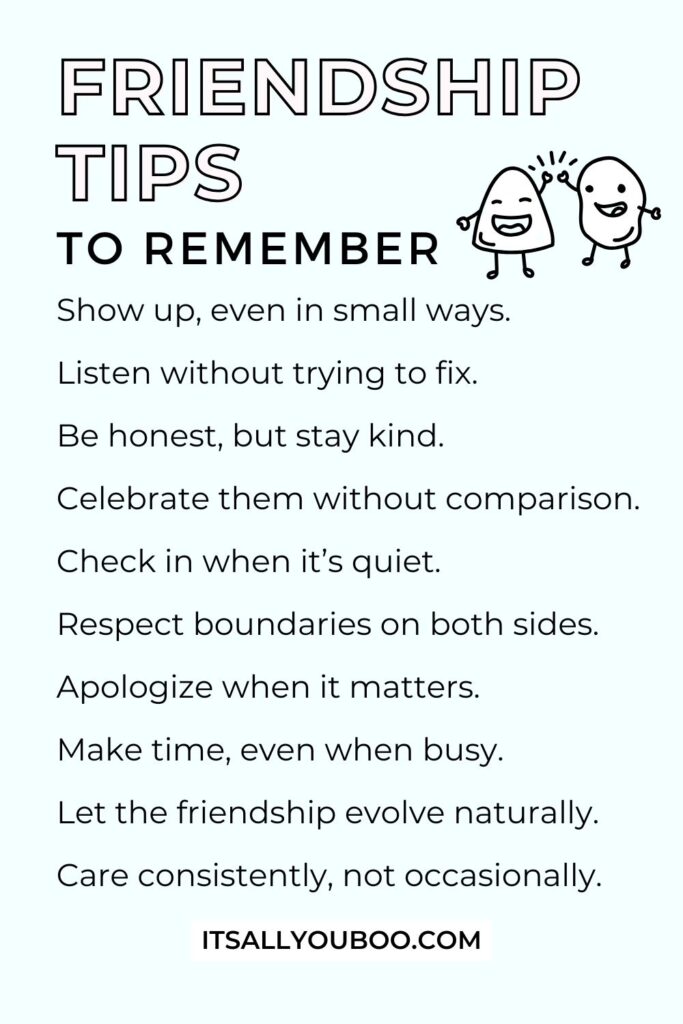
Not All Friendships Are the Same (And That’s Beautiful)
Here’s the first thing you need to understand: the friendships you have will be completely different in their own unique and special ways.
The friendship you have with your best friend is not going to be the same as the friendship you have with someone you meet at work. Or online. Or at the gym. Or on vacation.
The relationships you have with your childhood best friend are not going to be the same as relationships with friends you make as an adult.
And that’s okay. Actually, it’s more than okay. It’s beautiful.
Friendships don’t need to be one thing. Not every friendship will be at the same level. Not every friendship will look the same, or feel the same, or require the same things from you.
Just be open-hearted when it comes to friendship and realize that the diversity of connection is what makes it special.
- Your work friend with whom you grab lunch but never hang out outside the office? Valid friendship.
- Your online friend whom you’ve never met in person but text constantly? Valid friendship.
- Your childhood friend, whom you only see once a year, but can pick up with as if no time has passed? Valid friendship.
- Your best friend who knows everything about you, literally? Also valid, but different.
Stop trying to make all your friendships fit into one box. Let them be what they are.

It’s Okay to Not Have a Lot of Friends
Humans are all different. Newsflash, I know.
I know someone who has like 30 close friends. Who could throw a birthday party and pull 50 people they’re genuinely close with? That’s not me. I could pull maybe five people I’m close with. And that’s okay.
It doesn’t matter if you have a lot of friends or if you don’t have a lot of friends. Both are fine.
I’m a quality-over-quantity type of person. Really and truly, you just need one best friend and a couple of friends with whom you have unique connections.
Friends you can grab coffee with. Go on trips with. Send fun memes to. Exchange voice notes with. Make core memories with. Raise your children alongside.
You don’t need a lot of friends.
So don’t feel like something’s wrong with you because you don’t have a massive friend group.
Research from the Journal of Social and Personal Relationships shows that having a few close, quality friendships is more beneficial for mental health and well-being than having many superficial connections.
If you’re thinking, “I don’t have friends” right now, that’s okay, too. Start with one. Build from there.

Friendship Tips that are Adult Approved
#1. Show Up (This Is the Most Important One)
No matter what type of friendship you have, what age you are, I think at the end of the day, we’ll remember if you show up or you don’t show up.
Show up in the big ways and in the small ways.
Don’t just show up for weddings or milestone birthdays. Show up when your friend needs you emotionally. Show up when they need you to check in and make sure they’re okay.
Show up in their DMs. In their WhatsApp messages. However, it is how you communicate, just show up.
And you don’t need to be perfect. Show up as you are.
One of my recent decisions to end a friendship was because that person didn’t show up, even though they promised me they would. That was a really hard and really painful realization—that I would show up for them and they wouldn’t show up for me, even after promising they would.
I will always remember who was consistent, who was there, who reciprocated.
Your friends will remember too.
Being a good friend means showing up. Not just when it’s convenient. Not just when you feel like it. But consistently, over time, in ways big and small.
That’s what matters.
#2. Be Open and Be Friendly (It’s More Obvious Than You Think)
In order to make friends and keep friends, you need to be open and be friendly.
That might seem obvious, but hear me out.
I’ve been actively trying to make new friends in my hometown through meetup apps, like TimeLeft. I recently went to an event where there was just one other person.
And I can tell you, from their facial expressions and body language, I knew it was going to be a rough meal. I should have just turned around and walked away.
Because the words coming out of their mouth, their attitude, their personality, it all confirmed everything their body language told me before we even spoke one word.
It’s so clear to other people when you’re not open and when you’re not friendly. When you’re just not the type of person someone wants to be friends with.
Your internal attitudes confirm to others whether you’re someone they want to spend time with.

Be Mindful of How You Show Up
So be mindful of your body language. Be mindful of how you approach others and how you present yourself.
If you have negative mindsets—”nobody wants to be my friend,” “I have no friends,” “everyone betrays me,” “there’s nobody out here worth my time”—that’s what you’re manifesting and attracting.
Yes, someone literally said that last one at a meetup I attended. And yeah, you don’t want to be that person.
I always think when I go to events that I just want to make one friend. I’m just open to whoever the universe brings to me.
That openness? People can feel it. And it makes all the difference.
If you’re struggling with making new friends as an adult, start by checking your energy and your openness.
#3. There’s No Space for Anxiety in Friendship
Take it easy when making friends. That’s one of the best friendship tips.
Yes, be open, be friendly, but make sure you’re not putting out anxious attachment energies.
I get it. We can worry: “Why haven’t they replied? I haven’t heard from them. Did I say something? Did I do something?”
But that anxious energy can be repellent. Sorry for saying that, but it’s true.
Get your anxieties under control. Have confidence that you’re a wonderful person, that you’re interesting and engaging, and that people want to be your friend.
Nobody wants to be friends with someone who’s super anxious and—I don’t want to say needy—but there’s a not-so-attractive quality there that you want to avoid.
Have confidence in yourself.
Trust the friendship. Trust the connection. Don’t spiral every time someone takes a few hours to text back.
A new friend doesn’t owe you constant communication. A great friend will communicate when they can, but they also have their own life happening.
Give people grace. Give yourself grace. Relax into the friendship instead of gripping it so tightly it suffocates.

#4. Don’t Be Jealous, Territorial, or Competitive
I have had the pleasure of being part of many friend groups over the years.
And yes, I’m all for healthy competition. But be mindful of the negative effects that it can have, because not everyone can handle it. Not everyone is open to healthy competition.
And honestly, sometimes being competitive and possessive of friends is just off-putting.
For example, if you’re going to meet up with a friend and they say, “Hey, can I bring another friend?” just say yes and be open.
I know, especially if you’re a one-on-one type of person like me, you can be annoyed that you’re trying to do something special and they’re inviting other people.
But have the mindset that the friend of your friend is most likely going to become your friend too.
It’s Not always A Good Thing
On the subject of competitiveness, this can become a thing, especially when certain members of a friend group are attracted to another shared friend.
I’ve been in situations with other female friends who were kind of vying for the affection of a shared male friend, and things got weird and competitive.
Be mindful of these types of red flags among friends. Be discerning about whether they actually want to be your friend or if it’s proximity to someone else they’re after.
If it’s happened to me, I’m not the only person this has happened to.
Check your own jealousy. Check your own competitiveness. Be aware of these potential issues in friendships.
Being a great friend means celebrating when your friend makes other friends. It means not being territorial. It means being secure enough in your bond that you don’t need to guard it jealously.

#5. Always Be Yourself, No Matter What
I’ve been to quite a few conferences. Honestly, none of them have really led to any real friendships for me.
I always feel like the people I meet at these events, and I are just too dissimilar. Whether it’s ethnicity differences, mindset differences, whatever, it just never works out.
And I always come away wondering if they think I’m too much or too weird for them.
That can lead down a path of self-doubt.
So don’t doubt yourself. Be you. Show up as you are.
Yes, you might want to dial it back a bit. You don’t want to dump your trauma and drama on people you just met. Think of it like a first date—nobody wants to hear about your ex on a first date.
Same with making friends. Nobody wants all the trauma and drama right away.
That doesn’t mean you can’t tell interesting and engaging stories. Let your personality come out.
But basically, be yourself. Because if anyone is repelled by your true personality, your authentic weirdness and awkwardness, then let’s be real—they’re not meant to be your friend and they’re not going to be your friend.
Show up as you are and let go when it just doesn’t click or connect. You’re not going to click and connect with the vast majority of people out there. And that’s okay.
But don’t let a lack of connection close you off from making genuine friends.
Because the people who are your brand of awkward, your brand of weird, they’re going to be so drawn to you.
But they’ll never know that’s who you are if you hide it. Keep that friendship tip in mind.
#6. Be Your Own Friend First
If you can’t be friends with yourself, how can anyone else be your friend?
Be your own friend by being kind to yourself. Be interested in spending time alone, doing things you enjoy on your own.
This type of independence can be very attractive to other people.
If you want to do something, go do it. Post about it on social media. Be an interesting person.
You don’t need to be the most interesting person alive. But there’s something so cool and attractive about someone who is confident and assured, just doing their own thing.
People are curious about that person. People want to be friends with that person.
Think about the cool kid in school. You can achieve that by being your own friend first.
Love yourself. Pour into yourself.
And here’s the thing: how you treat yourself sets the tone for how others treat you.
If you talk shit about yourself, if you talk down to yourself, you’re laying the foundation that it’s okay for others to think and talk about you that way.
In all relationships, including friendships, you set the tone for how someone treats you. You’re the one who sets the ground rules.
So if someone is mistreating you, if someone is talking smack behind your back—and if someone’s talking crap about other people to you, know they’re probably talking crap about you too—just walk away.
It’s totally fine to let go and end that friendship.
Don’t let it be a fatal blow. There are more people out there who can love you and be your friend.
Understanding how to build strong relationships starts with how you relate to yourself.
#7. Communicate and Keep Communicating
Let your friends know what’s going on.
If they message, reply. I’m not saying you have to reply right away, but reply in a decent time.
Unless you’re slammed and super busy—and even if that’s the case, let your friends know: “Hey, I’m super busy right now. Sorry, I’m slow to respond.”
It doesn’t take that much to be communicative.
Or: “Hey, I’m going to take some time offline for a bit. I may not reply.”
If this is a friendship you care about, cherish, and value, be communicative. Let your friends know what’s going on.
That invites them to share with you what’s going on with them, too.
Don’t leave people in the dark. Don’t leave people hanging.
Nobody wants to be friends with someone who never replies to them. It’s just not fun.
As someone who has been friends in the past with people who were terrible at replying, it’s never a good feeling. And that leads to friendships ending.
If you care about that person, you can communicate.
You can send a voice note, which takes literally two seconds. You can use voice-to-text. It doesn’t take a whole lot to be communicative in this day and age.
No excuses.
Communication is key in relationships of all kinds, including friendships.

#8. Be Honest When You’re Struggling
Look, sometimes being a good friend is hard.
Maybe you’re going through your own stuff. Maybe your mental health is struggling. Maybe you just don’t have the capacity right now. That’s okay.
Being a better friend doesn’t mean being perfect. It means doing what you can with what you have.
Research shows that strong social connections improve mental health, but the relationship goes both ways—when your mental health is suffering, maintaining friendships can feel impossible.
So what do you do? Be honest. Tell your friends you’re going through something and you might not be as present as usual.
Real friends will understand. Real friends will give you grace.
And when you’re ready, show up again. That’s all you can do.
How Can You Be a Good Friend to Someone Going Through Hard Times?
This is where a lot of people struggle.
When a friend is going through something difficult—grief, breakup, job loss, mental health crisis, whatever it is—we often don’t know what to do or say.
So we do nothing. We say nothing. We disappear because we’re uncomfortable. Don’t be that person.
Here’s how to be a good friend during tough times:
- Show up. Even if you don’t know what to say. Your presence matters more than your words.
- Don’t make it about you. Don’t share your own similar story unless they ask. Just be there for them.
- Ask what they need. Don’t assume. Different people need different things. Some want to talk, some want distraction, some want practical help.
- Do something tangible. Bring food. Run errands. Handle logistics. Take action instead of just saying “let me know if you need anything.”
- Check in consistently. Not just in the immediate aftermath, but weeks and months later, when everyone else has moved on.
- Don’t disappear. Even if it’s uncomfortable, even if you don’t know what to say, stay present.
That’s what great friends do. Even just saying, “I’m here if you need me.” And be there if they need you.
#9. Give Your Friendships Time to Deepen
This is something people ask me all the time: how do you turn a regular friend into a best friend?
Here’s the truth: time.
Best friendships are built over time, through shared experiences, through showing up consistently, through being vulnerable, and being there when it matters.
You can’t force it. You can’t rush it. But you can invest in it.
Spend time together. Real, quality time. Not just surface-level hangouts, but time where you actually talk, where you share things, where you build memories.
Be vulnerable. Share the real stuff, not just the highlight reel.
Show up when it’s hard. Anyone can be there for the good times. Best friends show up for the bad times, too.
And let it develop naturally. The best friendships aren’t forced. They grow organically when two people consistently show up for each other over time.
If you’re looking to build deeper connections, even across distance, investing time and energy is key.
Being a Friend in the Social Media Age
Let’s talk about social media for a second.
Because it’s changed friendship in ways both good and complicated.
On one hand, social media lets us stay connected with friends across the world. We can see what they’re up to, celebrate their wins, and support them from afar.
On the other hand, it can create a false sense of connection where we think liking someone’s post counts as maintaining the friendship. It doesn’t.
Here’s my take: use social media as a supplement to friendship, not a replacement.
Comment on your friend’s posts. Share things that remind you of them. Celebrate them publicly. But also text them. Call them. See them in person when you can.
Don’t let your entire friendship exist on Instagram or TikTok or whatever platform.
Real friendship happens in conversations, in shared experiences, in showing up when it matters.
Social media can enhance that. But it can’t replace it.

Making New Friends as an Adult (Why It’s So Hard)
Making friends as an adult is really hard. I should have mentioned that friendship tip sooner.
When you’re a kid, friendships just happen. You’re in school together, you live in the same neighborhood, and you have built-in opportunities to connect.
As an adult? You have to actively seek out friendships. You have to put yourself out there. You have to be intentional about it.
And that’s scary. It’s vulnerable. It’s awkward. But it’s also necessary.
If you need to make new friends after moving or going through a life change, you have to be proactive about it.
Join clubs. Take classes. Go to meetups. Use friendship apps.
Put yourself in situations where you can meet people with similar interests. And then actually follow up. Making a new friend requires effort from both people.
Don’t just exchange numbers and never text. Don’t just say “we should hang out sometime” and never make plans.
Actually reach out. Actually make the plans. Actually show up. Don’t make plans, then constantly cancel.
That’s how you turn acquaintances into friends.
Studies show it takes about 50 hours of time together to move from acquaintance to casual friend, and about 200 hours to become close friends.
So it’s not going to happen overnight. You have to invest the time.
But when you find your people? It’s so worth it.
Being a Friend Means Accepting Change
Here’s something nobody tells you about long-term friendships: people change, you’ll change too.
Your friend at 25 is not going to be the same person at 35. Their priorities will shift. Their interests might change. Their entire life might look completely different.
And that’s okay. Being a good friend means accepting and supporting those changes.
It means not holding your friend hostage to who they used to be.
It means adapting as you both grow, sometimes together, sometimes in different directions.
Some friendships will grow with you. You’ll evolve together, your lives will change in parallel, and the friendship will deepen over time.
Other friendships will drift. You’ll grow in different directions, and that’s okay, too. Not every friendship is meant to last forever.
But the best friendships? They’re flexible. They adapt. They survive the changes because both people are committed to growing together or at least staying connected while growing separately.
My best friend from elementary school and I are not the same people we were as kids. We’re not even the same people we were five years ago.
But we’ve adapted. We’ve accepted each other’s changes. We’ve supported each other through every phase and evolution.
That’s what real friendship looks like over time.

Keeping a Friend Long-Term
So you’ve made a friend. How do you keep them? Consistency. That’s the secret.
Keep showing up. Keep communicating. Keep making time together a priority.
Check in regularly. Not just when you need something, but just to say hi, to see how they’re doing, to stay connected.
Celebrate milestones. Remember birthdays. Show up for important moments.
Forgive mistakes. Give grace. Don’t hold grudges.
Invest in the friendship. Put in effort. Don’t take it for granted.
And be willing to have hard conversations when needed. If something’s bothering you, talk about it. Don’t let resentment build.
Friendships, like any relationship, require work. But unlike romantic relationships, we often don’t treat friendships with the same level of care and attention. We should.
Good friends are rare. Great friends are even rarer.
When you find them, hold on to them. Put in the work. Show up.
They’re worth it.
10 Ways to Be a Good Friend (Quick Tips)
Was that a lot of friendship tips? Let me break this down into actionable ways you can show up as a great friend:
1. Listen Without Making It About You
When your friend is talking, really listen. Don’t just wait for your turn to talk. Don’t immediately relate everything back to your own experience.
2. Remember the Little Things
Birthdays, important dates, that job interview they mentioned, the thing they’re stressed about. Remember and follow up. Just add it all to your calendar.
3. Show Up Consistently
Not just for the big moments. Show up in the small, everyday ways. The text check-ins. The memes. The “thinking of you” messages.
4. Be Honest When It Matters
If your friend is about to make a huge mistake, say something. Be honest, but be kind about it.
5. Celebrate Their Wins Like They’re Your Own
No jealousy. No comparison. Just genuine happiness for your friend’s success.
6. Give Them Space When They Need It
Not everyone wants to talk about everything all the time. Respect when your friend needs to process alone.
7. Don’t Gossip About Them
Have their back when they’re not in the room. Don’t participate in conversations that tear them down.
8. Be Reliable
Do what you say you’re going to do. Show up when you say you’ll show up. Be someone they can count on.
9. Support Their Growth
People change. Let your friends evolve without making them feel guilty about it.
10. Make Time For Them
Life gets busy, but friendship requires time together. Make it a priority, not an afterthought.
Yes, You’re a Great Friend to Have
Look, friendship isn’t always easy.
It requires vulnerability. It requires effort. It requires showing up even when you don’t feel like it.
But good friendships? They make life so much better.
They give you people who see you, know you, and support you. They give you a sense of belonging. They make the hard times bearable and the good times even better.
So use these friendship tips. Show up for your people. Be the kind of friend you wish you had.
And if you’re struggling to make friends or keep friends, be patient with yourself. It takes time. It takes putting yourself out there. It takes being willing to be vulnerable and authentic.
But you can do this.
You’re worthy of great friendships. And somewhere out there, your people are looking for you, too. So take a deep breath. Send that text. Make those plans. Show up as you are.
Be more intentional with your friendship by setting friend goals together or making a list of things to do with your friends. Great friendships don’t happen by accident.
Your friend is waiting to hear from you.
It’s all you, boo.

More Friendship Tips
- 55 Thank You Quotes for Friends
- 21 Best Apps to Make Friends Around the World
- Have No Friends? Here’s How to Find People Who Support You
- How To Make New Friends In A New City (The Ultimate Guide)
- 25 Meaningful Ways to Give Back to The Community
- How To Stop Feeling Jealous in a Relationship or Friendship
- The Truth About Overcoming Insecurity And Jealousy In Life
- 7 Ways to Put Yourself Out There in College
- How to Finally Be Yourself Around Others
- How to Deal with Social Anxiety: 6 Tips for Today
- How to Stop Being Jealous and Envious of Others’ Success
- How to Make New Friends in 9 Unexpected Ways
- 38 Best Happy Valentine’s Day Quotes for Friends
- How to Maintain Long-Distance Friendships
- How to End A Friendship Without Drama
- 100 Friendship Goal List Ideas to Deepen Bonds
- How To Be A Good Friend: What True Friendship Looks Like
- 9 Friendship Tips for Adults Who Want Real Connections
- 100+ Things to Do with Friends At Home (When Bored)
- 15 Warning Signs of Fake Friendship
- How to Avoid Fake Friends
Last Updated on April 20, 2026


